
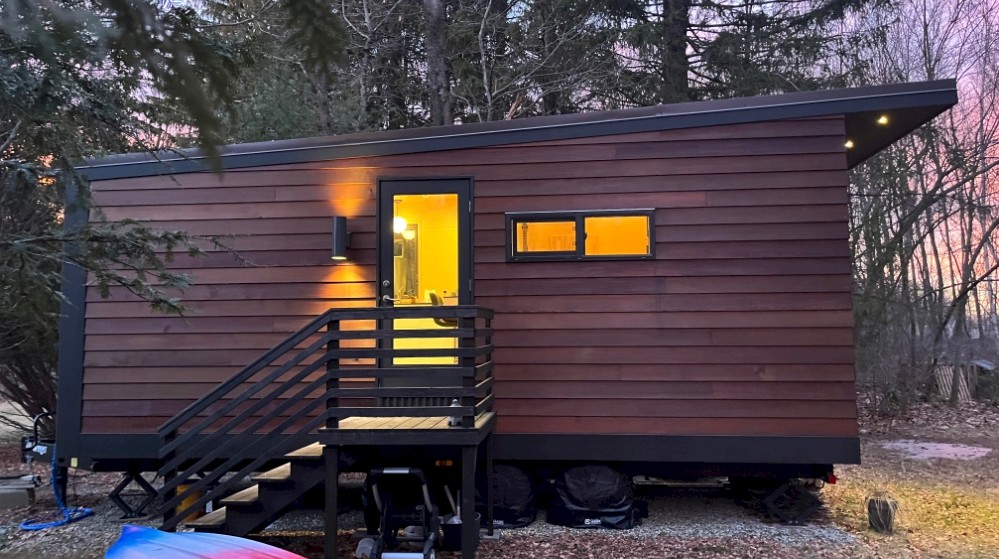
I recently joined the International Code Council’s (ICC) IS-OSMTH (International Standard for Off‑Site Construction — Modular Tiny House) committee as an interested party to the development of ICC 1215: Design, Construction, Inspection and Regulation of Tiny Houses for Permanent Occupancy. As a tiny home owner-builder myself, I’m excited about the prospect of helping tiny homes gain legitimacy in the marketplace, and a standard like ICC 1215 could provide a pathway for local jurisdictions to more easily adopt tiny house friendly policies while maintaining reasonable standards for safety.
After sitting in on my first meeting, it became apparent that there were some significant tensions between some of the interested parties and committee members and the rest of the committee regarding a change to the initial standard proposal which expanded the scope of the standard to include a new category of housing called the “Small Residential Unit” (SRU) and placed tiny houses under that. SRUs are defined in the draft standard as including homes up to 1200 sq ft, or 3 times the 400 sq ft max that currently defines a tiny house under the International Residential Code’s (IRC) Tiny House Appendix.
Several interested parties have brought up the fact that this change was made possibly in violation of ANSI procedures and that concerns and complaints about this change, when voiced, were repeatedly ignored, leading some to question the entire process and motivation behind the standard.
As an outsider to this process, I don’t want to unfairly judge anyone’s hearts or motivations. Some committee members, including Zack Giffin (of Tiny House Nation), have argued that the 1200 sq ft standard allows for flexibility in building tiny homes consisting of multiple units on separate chassis configured into a single home, but so far the standard is silent about this possibility or any further considerations it might require.
My own concerns come down to:
- Making sure the standard fills its intended niche in a way that makes it easily adoptable (and doesn’t get thrown out or ignored by jurisdictions due to overlap and confusion)
- Keeping the market for tiny homes affordable, fair, and open to small artisan builders and owner-builders.
I believe that the 400 square foot tiny house designation is relevant to these concerns, and I outlined my reasons in a comment sent to the ICC last week, which I’ve included here. Ultimately, I hope that these concerns can be addressed and we will have a standard that everyone can get behind.
You can sign the petitions and learn more here:
- Petition by Janet Thome of Tiny House Alliance USA (Contains helpful background & links)
- Petition by Macy Miller (owner-builder & architect)
- New blog by Macy (Good overview)
PINS Concern Regarding ICC 1215
I am submitting this comment in response to the revised PINS from May 16th, 2025 for ICC/THIA 1215-202x: Design, Construction, Inspection and Regulation of Small Residential Units and Tiny Houses for Permanent Occupancy.
The revised scope — covering residential units up to 1,200 sq ft — appears to duplicate and potentially conflict with existing ICC and federal standards, including:
- IRC, which already applies to homes of all sizes off-chassis
- HUD Manufactured Housing Code, which covers homes on chassis over 400 sq ft
- ICC 1200/1205, which apply to off-site construction
This lack of a clearly bounded scope introduces ambiguity and contradicts ICC’s responsibility to minimize conflict and overlap among its standards.
In particular, including homes well over 400 sq ft could:
- Dilute the effectiveness of the standard for truly small homes on chassis under 400 sq ft, which are currently not covered by an existing standard
- Create confusion for jurisdictions and inspectors already tasked with navigating IRC, HUD, and modular guidelines
- Overburden small builders and owner-builders, who are a primary stakeholder for tiny houses
Tiny homes under 400 sq ft present significantly lower structural and life safety risks than larger homes. This has important implications for:
- Regulatory burden (allowing a lighter regulatory touch)
- Affordability & housing access
- Owner-builder and small-scale builder feasibility
- Transportability on a chassis
- Reduced utilities requirements
- Greater design flexibility within the prescriptive code
In addition, “Tiny House” is an established and defined term within the IRC Tiny House Appendix. In contrast, the term “Small Residential Unit” (SRU) is a brand new term, encompassing a wider range of building types and stakeholders. The original intent of ICC 1215 appeared to be to provide a permanent chassis option specifically for structures already covered by the Tiny House Appendix, addressing a gap not covered by off-site or modular standards like ICC 1200 and 1205. Expanding the scope to include all SRUs up to 1,200 sq ft blurs the lines between these distinct groups, risks stakeholder confusion, and duplicates coverage already provided by existing ICC codes and federal standards.
I suggest that ICC 1215 either:
- Limit its scope to homes 400 sq ft and under, or
- Clearly divide the standard into separate tiers or sections, so that smaller homes are not subject to the same requirements as larger SRUs.
This will preserve the purpose, clarity, and usefulness of the standard — especially for jurisdictions and owner-builders seeking a practical, code-aligned pathway.
Sincerely,
Mike Spooner
Tiny Home Owner/Builder
Teaspoon Dwellings
Also of note: ASTM International also has created a subcommittee for developing tiny house standards. ASTM’s initiative began before ICC decided to develop their own standard.

Categories: Tiny House Codes
Comments: No comments yet
Post a comment